
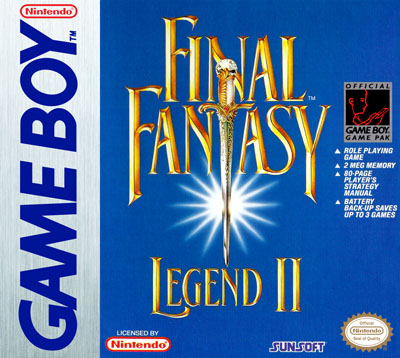
It’s December 6th, 1990. My birthday. And the present I have received is a Gameboy with Tetris, Super Mario Land, and Final Fantasy Legend 2. The first kept my attention for a few minutes. The second was too fast and too hard. But the third was just right for me.
This game is important to me, because it was the first I didn’t need to share with my brother. This was because, while I had an NES, I had to share it, but the Gameboy was my own and he wouldn’t get one until Pokemon hit.
Now, this review will also be a little different in that while I’ll be talking about the Gameboy version of this game, I’ll actually be playing SaGa 2: Hihou Densetsu Goddess of Destiny, which is a 3D remake of the same game for Nintendo DS in 2009. We never got this game, so I’ll be playing a fan translation of it, to see what changed about one of my favorite games.
First off, this isn’t a Final Fantasy game at all. It’s actually part of the SaGa series, which has much less linear gameplay than Final Fantasy. The Final Fantasy Legend series was it’s earliest games.
The game opens with a short cutscene talking about MAGI, or Relics, said to contain the power of gods, and the numerous lives they have ruined. About the people who fight for them, those that succeed and those that fail, but opening into a new saga of war. You are then prompted to create a main character. You are given eight choices, Human, Mutant/Esper, Robot, and three Monster types, with the first two choices having male and female options. Choose whichever you like. I remember choosing the male Human as a child.
The story continues that your father is taking off for some reason and gives you one of the most important Relics, the Spirit Mirror, which can detect other Relics. He then leaves, through the window, and you’re left to wonder what he’s up to. Time skips ahead a handful of years and, of course, in protagonist fashion, you’re following after him. You just need to stop by school to get some companions.
Now, most people suggest you use one Human, one Esper, one Robot, and one Monster. This is because Humans have the highest growth rate and use all weapons well, Espers grow a little slower, but get magical abilities to make up for it, Robots’ power is tied to how good their equipment is, while Monsters grow by eating monster meat, which causes them to change to different kinds of monsters.
As a child, I went with another Human, a female, a female Esper, and a Robot. For my DS playthrough, I went with a female Human, female Esper, and two Robots. This is because females start with higher Agility, which allows them to go first more often in combat, and they start with higher Magic stats, at the cost of lower Strength. It’s a lot easier to fix low Strength than it is to fix low Agility or Magic.
And that is because of this game’s leveling system. You do not level up like in traditional RPGs. Rather, your stats go up based on your various actions in combat for Humans and Espers. Thus, to get stats, you need to act. And it’s harder to gain stats when you are too slow to act. If you don’t get a turn, you don’t get stats. Thus why I start with females, since they start with high Agility. Moreover, having only one Human and one Esper lowers how many characters I need to worry about leveling up, while the Robots are powered up by what gear they have.
Upon attempting to leave town, your teacher, Mr S, will join your party as a guest. Guests cannot grow in power in Legend 2, so they’re just there to give you a hand. They are fully controlled by you and this will give you a chance to learn between the many combat actions and ranges, like single target attacks, group targetting, and attacks that target all foes. Moreover, you start to learn that your characters have a limited inventory, so you can only wear so much armor and weapons. This is especially true for the Esper, who can have up to four magical abilities.
And you may notice the next oddity in this time. Weapons, spells, and the like have limited uses. If you run out of uses, a weapon will break while spells need to be recharged by staying at an inn. The exception to the weapon rule is any weapon given to a Robot, which will have it’s uses halved, but be capable of being ‘repaired’ by staying at the inn.
For your starting party, you may notice you have, using the party I’m using in DS, a Rapier on your Human, a Bow and Flame spell on the Esper, and Derringers (Colts) on the Robots. You may also notice the Rapier and Bow have 50 uses while the Derringers only have 25. Do not worry about this, as the Robots can have their stuff repaired back up to 25 uses. Though keep in mind that the maximum is based on how many uses the weapon had when it was given to the Robot. So if you give them a weapon and it’ll only have 10 uses on it, 10 is it’s maximum. Think carefully before giving anything to a Robot in this game.
Every character also has eight inventory slots, so along with the weapons and spells, each character also comes with some armor and, for the robots, passives. Robots start with an ability called OPara/Poison. This means they are immune to status effects, other than petrification. This sounds great, but it comes at a cost; it takes up an inventory slot. That’s one less slot than you’d normally get. Moreover, in combat, armor shows up in your attack list, so I recommend moving your armor to the bottom of your inventory.
The game features a world to world system, as you travel between them to gather more Relics, you will find each world is different from the last, with new things to find, new enemies to fight, and villains to thwart. Which is a good thing, as this game doesn’t need to commit to a theme this way. You’ll find weapons from swords to guns to even things like lasers and nukes, with your magic getting stronger and even finding tomes your non-Espers can use to cast spells. And some weapons work very differently, like martial arts or the various psychic weapons, which work like normal weapons but use the Magic stat instead of Strength or Agility.
The beauty of this game really comes down to the wide variety of options it gives you to solve problems. Since it has a party system that allows for a wide variety of character combinations, some of which will make the game harder and some easier. Will you brute force the game with Humans and Robots? Or perhaps go ability heavy with Espers and Monsters? Or will you do something more balanced? Or even something crazy like all Monsters? All Robots? Any party can work, so it lets you choose how you want to tackle the game. You could choose to ignore the strange leveling system entirely with a party of Robots and/or Monsters.
Those are the reasons I love this game. It’s just such a good game and I enjoy it enough to easily recommend it. It does, however, feel a little too grindy at times, as you sometimes need some health growth only for the game to be stubborn or need a little more Agility or Strength to get passed a boss, only to get tons of health instead. It happens, but it never feels like a deciding factor. Try a different strategy, try new weapons, new spells. Maybe go back a world or two for older weapons that run off different stats, like the psychic weapons. Or just load up on guns and goto town on your foes. There’s always another way with this game.
Sadly, I cannot say the same for the rest of the SaGa series. Final Fantasy Legend 2 and 3 were really my only major exposure to the series, so I cannot speak for it as a whole. I’ll have to get to Legend 3 someday, since it also has a DS remake.
Now, if you’ll excuse me, SaGa 2 DS is demanding my attention.
Highly recommended (Both versions)
 The Professional Protagonist